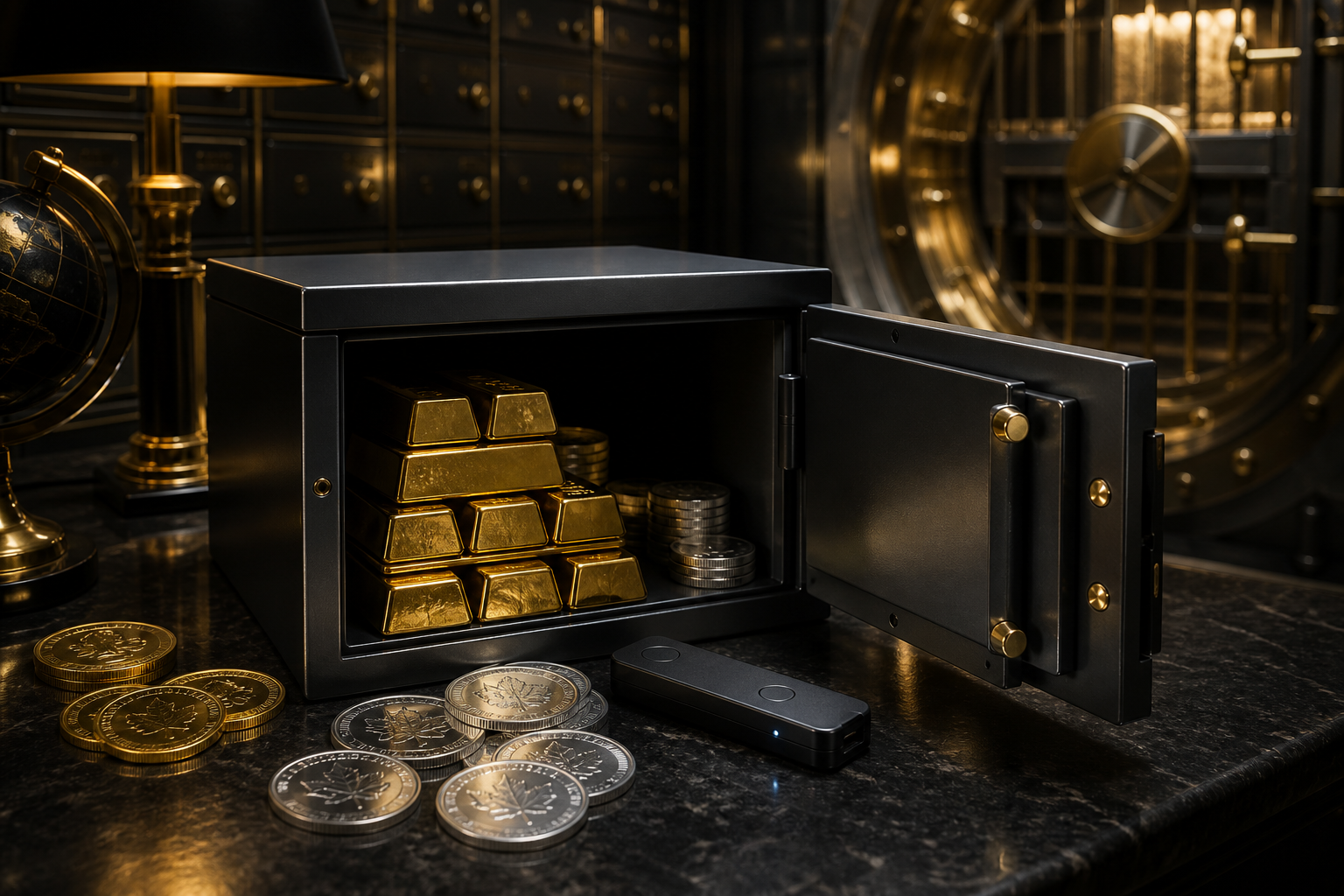
La decisión que afecta a cada gramo que compras
Cuando conviertes Bitcoin o Monero en oro físico, la forma que adopta ese oro importa más de lo que la mayoría de los compradores espera. Las monedas y los lingotes son ambos oro con una pureza del 99,9 %+ en la mayoría de los casos, pero se comportan de manera diferente en cuatro dimensiones clave para los tenedores de cripto: prima sobre el precio spot, liquidez, divisibilidad y eficiencia de almacenamiento.
Esta guía analiza cada factor para que puedas elegir el formato adecuado según tus objetivos reales.
---
Las primas: lo que realmente pagas por encima del spot
Cada pieza de oro físico incorpora costes de fabricación y distribución además del precio del metal en bruto — esto es la prima sobre el precio spot.
- Las monedas suelen tener primas más altas que los lingotes de peso equivalente. Una moneda de oro de 1 oz (Maple Leaf, Britannia, Filarmónica de Viena) se negocia frecuentemente en el mercado minorista con un 3–6 % sobre el spot, a veces más en el caso de emisiones numismáticas o limitadas.
- Los lingotes de refinerías acreditadas (PAMP, Valcambi, Argor-Heraeus) suelen tener primas más bajas — a menudo del 1–3 % en lingotes de 1 oz, y aún menos en los de 100 g o 250 g.
- Cuanto más pequeño, más caro por gramo. Un lingote o una moneda de oro de 1 g tiene una prima porcentual mucho más alta que un lingote de 100 g, porque el coste fijo de acuñación se reparte entre menos metal.
En SwissGoldXMR, la prima de plataforma es un transparente 2 % sobre todo el catálogo, pero la prima del producto subyacente sigue variando según el formato y el peso — por lo que el coste total de una moneda de 1 g difiere del de un lingote de 100 g incluso antes de la comisión de plataforma.
---
Liquidez: ¿con qué facilidad puedes vender?
La liquidez indica con qué rapidez y a qué precio puedes convertir tu oro de nuevo en efectivo o cripto.
Las monedas tienen un mercado secundario natural. Las monedas acuñadas por gobiernos reconocidos — Krugerrand, Maple Leaf, Britannia — son negociadas en todo el mundo por distribuidores, coleccionistas e inversores. Un distribuidor en cualquier parte del mundo puede verificarlas y valorarlas en cuestión de segundos.
Los lingotes requieren verificación por ensayo si salen de la cadena de una cámara acorazada acreditada. Un lingote sellado, acreditado por la LBMA y almacenado continuamente en una cámara acorazada suiza, mantiene su cadena de integridad. Si esa cadena se rompe alguna vez, un comprador puede exigir un ensayo antes de adquirirlo, lo que añade costes y demoras.
Para los tenedores de cripto que valoran una salida rápida y sin fricciones, las monedas ofrecen una ligera ventaja en liquidez — especialmente en denominaciones pequeñas. El programa de cámara acorazada suiza y recompra cubre ambos formatos, pero conviene entender esta distinción si alguna vez deseas recibir entrega física.
---
Divisibilidad: gastar y reequilibrar por partes
Uno de los argumentos más sólidos a favor de las monedas es su divisibilidad natural.
- Una cartera de diez monedas de 1 oz puede liquidarse moneda a moneda. Vendes el 20 % de tu posición sin tocar el resto.
- Un único lingote de 10 oz es una unidad indivisible. Para salir parcialmente, tendrías que vender el lingote completo y recomprar uno más pequeño — asumiendo dos conjuntos de spreads.
Para los tenedores de cripto acostumbrados a enviar 0,05 BTC o 3 XMR, la idea de un control granular sobre una posición resulta intuitiva. Las monedas replican esa flexibilidad en metal físico.
La contrapartida: pagas una prima por gramo más alta por esa flexibilidad. Si estás construyendo una reserva de valor a largo plazo y no prevés ventas parciales, los lingotes más grandes son más rentables.
---
Eficiencia de almacenamiento: un factor menor pero real
Los lingotes son más densos y uniformes en forma, lo que significa que ocupan menos espacio en cámara acorazada por gramo de oro. Para grandes patrimonios, esto puede reducir marginalmente los costes de almacenamiento con el tiempo. Para la mayoría de los compradores minoristas, esta diferencia es insignificante — pero vale la pena conocerla si piensas a gran escala.
---
¿Qué deberías elegir?
Aquí tienes un marco de decisión práctico:
Elige monedas si: - Compras menos de 50 g en total y quieres flexibilidad - Es posible que en algún momento quieras recibir entrega física - Valoras la liquidación parcial sin reestructurar toda tu posición - Quieres el mercado de reventa más amplio posible
Elige lingotes si: - Compras 100 g o más y minimizar la prima es la prioridad - Planeas mantener a largo plazo en cámara acorazada sin tocarlo - Te sientes cómodo con la documentación de cadena de custodia de la cámara para gestionar la liquidez - Quieres el máximo metal por cada franco gastado
---
Un enfoque mixto suele tener sentido
Muchos compradores experimentados mantienen una posición principal en lingotes de mayor tamaño por eficiencia de costes, y reservan una asignación más pequeña en monedas de 1 oz para liquidez y opcionalidad. Piénsalo como una cartera cripto: grandes capitalizaciones para la estabilidad, una capa líquida para la flexibilidad.
Consulta la gama completa de formatos disponibles en el catálogo, o lee cómo funciona para entender cómo los pagos en cripto se convierten en metal asignado y custodiado en cámara acorazada desde el momento de la compra.
Si no sabes por dónde empezar, el formato importa menos que el hecho de empezar. El mejor patrimonio en oro es el que realmente posees.
¿Listo para tener metal suizo de verdad?
Explorar el catálogo